

Sustainability is not a label.
It is a system of decisions about materials, energy, chemistry and scale.
At BIOMA, we approach environmental performance through structured assessment rather than marketing claims. Our laminated coffee-based biomaterial is currently being assessed using a cradle-to-gate life cycle framework aligned with ISO 14040 and ISO 14044 principles.
Cradle-to-Gate Assessment
Our current assessment evaluates environmental impacts from raw material sourcing through manufacturing in Barcelona.
Included
Collection of post-consumer coffee waste (local HORECA)
Binder production (mixed biopolymer matrix)
Textile backing production
Drying, blending, thermal pressing, lamination
Internal reprocessing of offcuts
Excluded
– Product use phase
– End-of-life
– Capital equipment
Waste Instead of Extraction
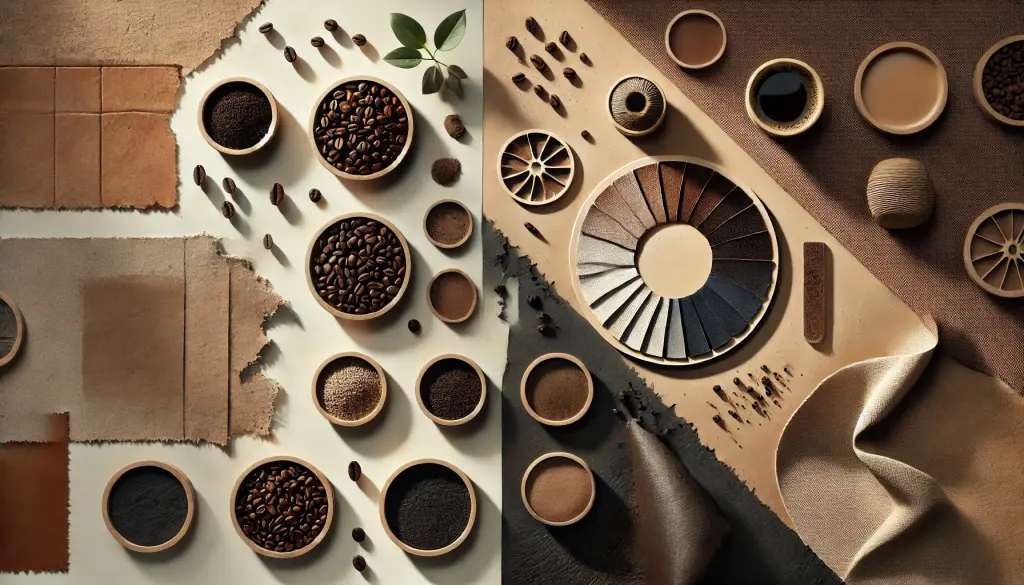
BIOMA’s primary raw material is spent coffee grounds collected locally in Barcelona. Using post-consumer waste reduces reliance on virgin agricultural inputs and shortens supply chains.
Unlike crop-based “bio” materials, our material begins with urban residue rather than cultivated land.
Energy Profile (Current Phase)
Production currently takes place in a semi-industrial workshop. Drying and thermal pressing are the primary energy-intensive stages.
0.19
kWh per m²
Structured sensitivity range: 0.06 – 0.35 kWh per m²
Material Composition Variables
The environmental profile of the BIOMA material is strongly influenced by:
Binder Composition
Bio-based vs fossil-derived fraction of the biopolymer matrix.
Binder Ratio
30–70% range depending on the specific configuration.
Textile Backing
Type and weight variables for final lamination.
Comparative Benchmark Framework
For internal reference, BIOMA compares its laminated configuration against published cradle-to-gate values for PU-coated and laminated fabrics.
Published peer-reviewed studies report climate change impacts for conventional PU-coated and laminated fabrics in the range of 1.42 to 1.72 kg CO2e per square metre (cradle-to-gate). Our electricity contribution alone represents a fraction of this range.
However, full environmental comparison requires complete data on binder composition and textile backing, which we are currently quantifying. We will not publish comparative superiority claims until we have equivalent datasets and functional equivalence testing.
We also benchmark against emerging bio-based alternatives including cactus leather, grape leather, and mycelium composites. These comparisons help us understand where coffee-based biomaterials fit within the broader landscape of sustainable material innovation.
Chemical Compliance
The BIOMA material system avoids PVC, phthalates, and heavy metals. Supplier Safety Data Sheets (SDS) are being consolidated as part of EU Ecolabel readiness preparation.
Certification Pathway
EU Ecolabel criteria mapping is currently underway. This includes identification of restricted substances, performance thresholds, and traceability requirements.
Certification Roadmap
Three Certifications in Preparation
EU Ecolabel for Textiles
The EU Ecolabel is the European Commission’s official voluntary environmental label. Our assessment covers restricted substances, fibre sourcing, manufacturing processes, fitness for use, and social responsibility criteria. We are mapping our evidence base against Commission Decision 2014/350/EU. This is a preparation exercise. We do not claim compliance until formal verification is complete.
OEKO-TEX Standard 100
OEKO-TEX Standard 100 tests for harmful substances in textiles at every stage of production. Testing parameters include formaldehyde, extractable heavy metals, pH value, and pesticide residues. This is likely to be the first certification we pursue formally, as our material composition aligns well with the standard’s requirements.
Global Recycled Standard (GRS)
The GRS verifies recycled content, chain of custody, and responsible social and environmental practices across the supply chain. Our use of post-consumer coffee waste positions us well for this certification, and we are building the traceability documentation required for third-party audit.
Physical Testing Evidence
Laboratory Characterisation
Physical testing of our material variants was conducted at SENA laboratory in Colombia. Nine material configurations were tested across multiple parameters including thickness, water absorption, temperature resistance, and cut and puncture resistance.
Our coffee-based samples showed thermal stability up to 200°C, with measurable degradation beginning at 250°C. Water absorption behaviour varies significantly between single-face and double-face textile configurations, providing useful data for product development decisions.
We are currently mapping these results against six international ISO test standards as part of our certification readiness work. Where gaps exist between our current data and formal certification requirements, we are planning targeted testing programmes.
Our Approach to Transparency
BIOMA avoids absolute environmental claims. We distinguish clearly between measured data and modelled estimates. We publish improvements as they are verified.